English

The Stringent Demands of API and Fine Chemical Synthesis
In the manufacturing of Active Pharmaceutical Ingredients (APIs) and high-value fine chemicals, fluid transfer systems are subjected to the most rigorous regulatory and operational constraints in the industrial sector. The synthesis processes utilize highly aggressive, flammable, and toxic organic solvents alongside concentrated mineral acids. The pumping infrastructure must fulfill a dual mandate: it must protect the purity of the process fluid while ensuring the safety of the plant personnel and the environment. Introducing trace metal contaminants from a degrading pump casing into a reaction vessel will instantly ruin an expensive batch and violate strict pharmaceutical quality standards. Developing reliable process pump solutions for this sector requires transitioning from standard industrial equipment to specialized, high-purity sealless architectures.
Analyzing Centrifugal Pump Problems in Solvent Transfer
Standard industrial centrifugal pumps rely on a rotating shaft penetrating the pump casing to drive the internal impeller. The clearance between this rotating shaft and the stationary casing must be sealed, typically utilizing a dynamic mechanical seal. In the context of fine chemical synthesis, this mechanical seal is the primary point of catastrophic failure.
The Failure of Mechanical Seals in Volatile Media
Dynamic mechanical seals function by maintaining a microscopic hydrodynamic fluid film between a stationary ring and a rotating ring. This fluid film provides necessary lubrication and carries away friction heat. However, pharmaceutical processes frequently involve transferring low-boiling-point solvents such as toluene, methanol, acetone, and dichloromethane. When these highly volatile solvents migrate to the low-pressure atmospheric side of the mechanical seal, they flash and evaporate instantly. The seal faces are stripped of their lubricating film and experience dry friction. This dry running condition leads to immediate thermal cracking of the seal faces, resulting in the leakage of highly flammable and toxic vapors into the plant environment. The definitive chemical pump solution to this structural vulnerability is the complete eradication of the dynamic shaft seal.
Sealless Magnetic Drive Architecture: The Zero-Leakage Solution
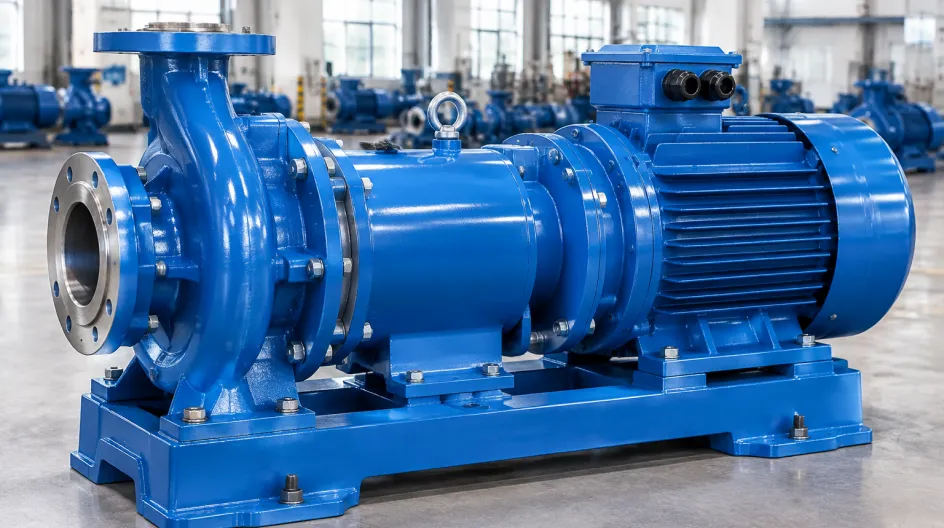
To safely handle hazardous solvents and valuable APIs without the risk of fugitive emissions, engineers deploy sealless magnetic drive technology. Pumps utilizing this architecture (such as the CQB and ZMD series) physically decouple the electric motor from the internal impeller assembly.
Synchronous Magnetic Torque Transmission
The magnetic drive mechanism consists of an outer magnetic rotor affixed to the drive motor shaft and an inner magnetic rotor embedded within the impeller. A stationary, hermetically sealed isolation sleeve (containment shell) is installed between the two rotors, acting as the primary pressure boundary. As the motor turns, the magnetic flux crosses the isolation sleeve and locks with the inner rotor, driving the impeller synchronously. Because there is no physical shaft penetrating the pump casing, dynamic mechanical seals are completely eliminated. The dynamic shaft seal is eliminated as a leak path, with containment provided by a single static O-ring that fulfills strict environmental containment protocols and occupational safety standards.
Evolving Beyond Metallic Isolation Sleeves
While metallic magnetic drive pumps offer zero leakage, they present a specific thermodynamic problem when transferring volatile solvents. The rotating magnetic field generates electrical eddy currents within a metallic isolation sleeve. These eddy currents produce significant thermal energy, which is absorbed directly by the process fluid circulating inside the containment shell.
For low-boiling-point solvents, this localized heat addition can raise the fluid temperature above its vapor pressure limit, causing the solvent to boil and form vapor bubbles inside the pump (cavitation). Advanced industrial pump solutions utilize high-strength, non-metallic fluoroplastic isolation sleeves. Because fluoroplastics are electrically non-conductive, they eliminate eddy current losses. This non-metallic design prevents unwanted heat transfer, maintains the liquid state of the volatile solvent, and maximizes the overall electrical efficiency of the drive motor.
Material Science: Guaranteeing API Purity with Fluoroplastics
Protecting the chemical integrity of the pharmaceutical product is just as critical as preventing leaks. Standard stainless steel pumps (including 316L) rely on a passive oxide layer for corrosion resistance. Hot acids and reactive halogenated solvents can strip this oxide layer, causing the steel to actively corrode and leach heavy metal ions (such as iron, nickel, and chromium) directly into the API mixture. This ionic contamination compromises the chemical synthesis and leads to rejected batches.
The F46 Composite Architecture
To provide the required chemical inertness, high-purity process pumps utilize composite structures. The heavy-duty outer casing is cast from iron or steel to withstand piping loads, structural stress, and internal system pressures up to 1.6 MPa. The entire internal wetted cavity is heavily lined with F46 (Fluorinated Ethylene Propylene, FEP) fluoroplastic through a high-temperature sintering process.
F46 provides near-universal chemical resistance. The pharmaceutical solvent or acid only ever contacts the inert fluoropolymer, ensuring that no metallic ion leaching or chemical attack on the pump body occurs. This composite approach provides the structural rigidity of a metallic pump with the contamination-free purity of a solid plastic pump, making it the designated standard for fine chemical reactors and high-purity filtration skids.
Reactor Emptying and IBC Unloading: Magnetic Self-Priming Integration
Fine chemical facilities utilize diverse fluid storage mechanisms, including underground solvent tanks, low-level reaction vessels, and Intermediate Bulk Containers (IBCs). Unloading these containers from the top is often mandated by safety protocols to prevent catastrophic bottom-valve failures. However, standard magnetic drive pumps require a flooded suction and cannot evacuate air from an empty pipeline.
The ZMD magnetic self-priming pump resolves this logistical constraint. This specialized pump integrates a gas-liquid separation chamber directly into the fluoroplastic-lined volute. Before the initial startup, the casing is manually filled with the process solvent. Upon activation, the pump evacuates air from the suction pipeline, mixing it with the retained liquid and venting the gas through the discharge line. This creates a vacuum, allowing atmospheric pressure to lift the fluid vertically out of the underground tank or IBC. Once the initial prime is established, the pump automatically retains sufficient liquid to re-prime on all subsequent operations without requiring a foot valve. This allows operators to combine the zero-leakage safety of a magnetic drive with the vertical lift capability of a self-priming pump.
Engineering Safeguards: Protecting Internal Tribology
Because the inner rotor of a magnetic drive pump is completely enclosed within the isolation sleeve, it must be supported by internal bearings submerged in the fluid. These applications utilize highly pure Silicon Carbide (SiC) bearing assemblies due to their extreme hardness and chemical resistance.
These SiC bearings rely strictly on the pumped fluid to generate a hydrodynamic lubricating film and to carry away the friction heat generated during rotation. Operating a magnetic drive pump completely dry will cause the ceramic bearings to experience rapid thermal shock and potential shattering within seconds. Comprehensive pump solutions require the implementation of active dry-running protection. Plant engineers must install motor power monitors or inline flow switches that instantly detect a loss of fluid and cut power to the motor, protecting the internal magnetic assembly from operator error or empty supply tanks.
Evaluating Your Pharmaceutical Fluid Transfer Infrastructure
In fine chemical and API manufacturing, standardizing on equipment that eliminates the dynamic shaft seal as a leak path and protects fluid purity is critical for profitability and regulatory compliance. Relying on standard mechanical seals for volatile solvent transfer introduces unacceptable risks of fugitive emissions and batch spoilage. By transitioning to fluoroplastic-lined, sealless magnetic drive technologies, facilities eliminate the primary causes of pump failure and secure a stable, pure fluid transfer loop. Our engineering team specializes in mapping volatile fluid dynamics, specific gravities, and vapor pressures to the optimal sealless configuration. Contact us to initiate a comprehensive technical review of your solvent unloading stations, reactor feed lines, and filtration skids.
Frequently Asked Questions (FAQ)
1. Why do mechanical seals fail so frequently when pumping solvents like toluene or acetone?
Dynamic mechanical seals require a liquid film between the seal faces for lubrication and cooling. Highly volatile solvents have low boiling points and tend to flash into a gas as they migrate across the seal face. This strips the seal of its lubrication, causing dry friction, rapid heat buildup, and ultimate catastrophic failure of the seal components.
2. How does a sealless magnetic drive pump prevent fluid contamination?
A sealless magnetic pump completely eliminates the shaft penetration and the dynamic mechanical seal. By utilizing a static, non-metallic isolation sleeve and lining the entire wetted path with inert F46 fluoroplastic, the pump hermetically seals the fluid. This ensures no external contaminants can enter the system and no heavy metal ions leach into the pharmaceutical product.
3. What is the advantage of a non-metallic isolation sleeve in a magnetic pump?
When an electric motor drives a magnetic coupling through a metallic sleeve, it generates electrical eddy currents that heat the surrounding fluid. A non-metallic, fluoroplastic isolation sleeve eliminates these eddy current losses in the sleeve. This is critical for preventing low-boiling-point solvents from vaporizing inside the pump casing and maximizing overall motor efficiency.
4. Can a magnetic drive pump lift fluid out of an underground solvent tank?
A standard magnetic drive pump (like the CQB series) cannot; it requires a flooded suction. However, our ZMD series is a specialized magnetic self-priming pump. It combines the zero-leakage safety of a magnetic drive with an integrated priming chamber, allowing it to lift fluids vertically from underground tanks and IBCs without requiring a foot valve.
5. Are fluoroplastic lined pumps suitable for high-temperature chemical reactions?
Our standard F46 (FEP) fluoroplastic-lined centrifugal pumps can safely handle continuous fluid temperatures up to 100°C, and specific structural configurations can accommodate up to 150°C. For temperatures significantly higher than this, we recommend utilizing our solid stainless steel magnetic drive pumps (CQL series), which offer greater high-temperature dimensional stability.
6. How do I protect my magnetic drive pump from dry-running damage?
The internal silicon carbide bearings in a magnetic pump will shatter if operated without fluid lubrication. You must install an active monitoring system, such as an electronic motor power monitor. This device detects the sudden decrease in electrical load that occurs when the pump loses fluid and automatically shuts off the motor before thermal damage occurs.
-

YFTEL Pumps
Fluid Engineers & Technical Support, YFTEL Pump
YFTEL is a chemical pump manufacturer based in Hangzhou, China, with a 26,000 m² production base in Hangzhou, China, with a 26,000 m² production base in Anhui. Using the CAS-patented Fluoroplastic Alloy material, we produce 300+ models of corrosion-resistant pumps, valves and piping, exported to 30+ countries.