
 English

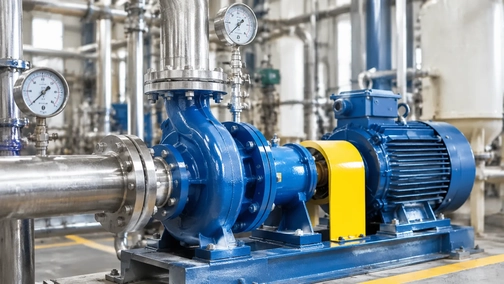
Solvents, fuels and many chemical vapors form explosive atmospheres, and chemical pumps work inside them every day: transferring acetone between tanks, unloading tankers of methanol, circulating toluene through reactors. A pump concentrates rotating machinery, heat and a flammable fluid in one casing, so European law treats it as potential ignition equipment in its own right. Under the ATEX framework, a pump installed in a classified area must carry the correct equipment category, gas group and temperature class — and the responsibility for matching them is shared between the site operator and the pump manufacturer.
The Legal Framework in Brief
Two directives govern explosive atmospheres in the EU. Directive 1999/92/EC (the workplace directive) obliges the operator to assess where explosive atmospheres can occur, divide the site into zones and document everything in an explosion protection document. Directive 2014/34/EU (the equipment directive) obliges manufacturers to build equipment that cannot ignite those atmospheres. Pumps fall squarely inside the second directive as non-electrical equipment with their own potential ignition sources, alongside gearboxes and couplings. The technical route to compliance runs through EN ISO 80079-36, which sets the basic ignition-hazard assessment for non-electrical equipment, and EN ISO 80079-37, which defines the recognized protection concepts: constructional safety "c", control of ignition sources "b" and liquid immersion "k".
The conformity burden scales with risk. Category 2 non-electrical equipment — the class most chemical pumps occupy — can be self-assessed by the manufacturer, but the full technical documentation must be deposited with a Notified Body. Category 3 equipment uses internal production control only. One rule deserves emphasis: any modification to a certified pump voids the declaration of conformity, because the modifier takes on the manufacturer's obligations.
Zones, Categories and the Marking
The operator's zone classification drives the equipment category you must buy:
| Zone (gas) | Atmosphere present | Minimum category | EPL |
|---|---|---|---|
| Zone 0 | Continuously or for long periods | 1G | Ga |
| Zone 1 | Likely in normal operation | 2G | Gb |
| Zone 2 | Unlikely, and only briefly | 3G | Gc |
Dust atmospheres follow the same logic with zones 20/21/22 and categories 1D/2D/3D. A higher category always covers a lower-risk zone — a 2G pump is legitimate in Zone 2 — while a lower category can never move upward. A certified pump carries its capability on the nameplate. Decoding a typical marking, II 2G Ex h IIB T4 Gb:
- II — equipment group II, for surface industries (group I is mining)
- 2G — category 2, gas atmospheres, so permitted in Zone 1 and Zone 2
- Ex h — explosion-protected non-electrical equipment per EN ISO 80079-36/-37
- IIB — gas group, qualified for ethylene-class gases and everything less demanding (IIA, propane class); group IIC covers hydrogen and acetylene, the most easily ignited gases
- T4 — maximum surface temperature 135°C in any foreseeable condition
- Gb — equipment protection level "high", consistent with Zone 1
The temperature class anchors to the fluid, not the pump alone: the rated surface temperature must stay below the auto-ignition temperature of every gas or vapor present, with engineering margin. The scale runs T1 (450°C) through T6 (85°C); T4 at 135°C suits most common hydrocarbons and solvents, which is why it dominates chemical-plant specifications. Some pump markings carry an X suffix or a temperature range such as T6–T4, because the real surface temperature follows the pumped medium's temperature — the special conditions of use in the manual then become part of the certification.
How a Pump Becomes an Ignition Source
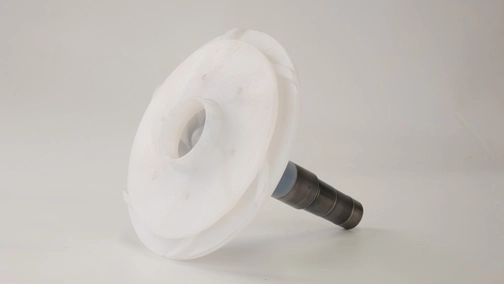
ATEX assessment starts from the ways a pump can ignite its surroundings. Hot surfaces come first: bearings running dry, a misaligned coupling or a shaft seal in distress can push local temperatures past the gas ignition point, which is why the T class exists and why bearing temperature monitoring appears in so many pump specifications. Mechanical sparks and hot spots follow when rotating parts contact stationary ones — an impeller touching the casing after bearing failure is the classic scenario, and it drives the mandated running clearances. Electrostatic charge accumulates on non-conductive components, a live issue for fluoroplastic-lined pumps; certified designs use conductive or surface-resistivity-controlled lining grades and bonded grounding paths. Dry running deserves its own line for magnetic drive pumps: without pumped liquid, the containment shell heats rapidly in the eddy-current field, so low-flow and dry-run protection is an ignition-protection measure, and not merely an equipment-saver.
Engineering Requirements for an ATEX-Rated Pump
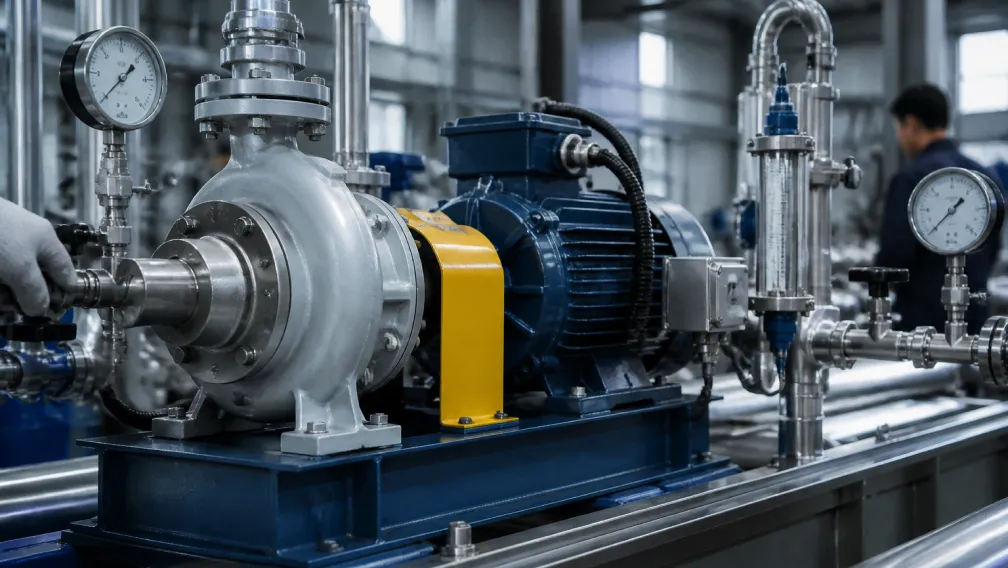
A compliant pump is a certified system, and the assessment covers the pump, coupling and driver as one unit. The typical engineering package for a chemical pump in Zone 1 or Zone 2 includes:
- Ignition-hazard assessment per EN ISO 80079-36 across normal operation and expected malfunctions
- Protection by constructional safety "c" — generous clearances, controlled surface temperatures, spark-safe material pairings — with ignition-source control "b" added where sensors supervise bearings and temperatures
- Bearing and, where applicable, seal temperature monitoring with alarm and trip
- Dry-run and minimum-flow protection for magnetic drive designs
- Electrostatic control: conductive lining grades, grounded metallic shell, verified bonding of all accessible metal
- A motor certified to its own electrical protection concept — flameproof Ex db or increased safety Ex eb — with a gas group and T class matching or exceeding the pump unit's rating; drives run on VFDs need motors explicitly certified for converter operation
- EU Declaration of Conformity, the instruction manual with its X conditions, and the deposited technical file
Pump Types in Explosive Atmospheres
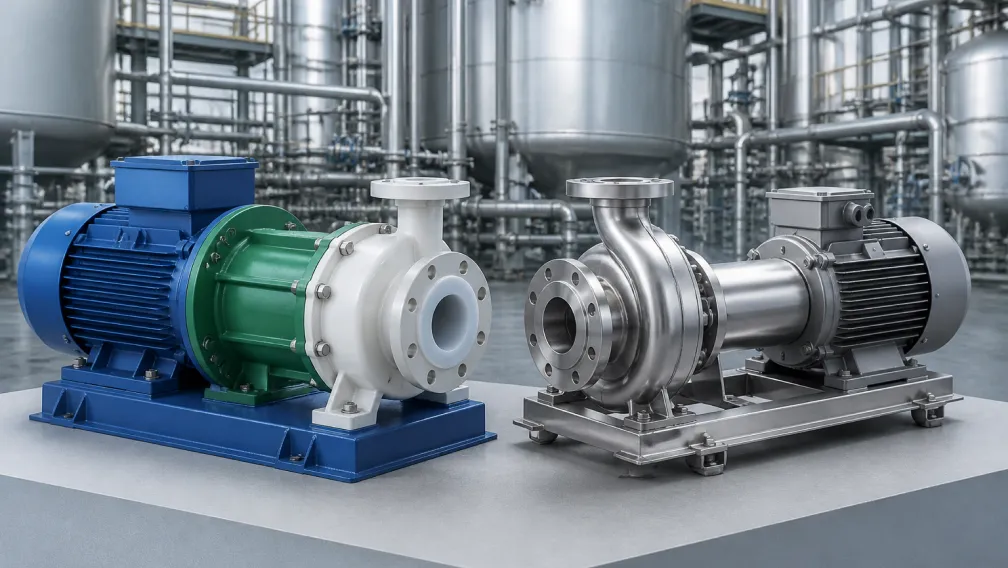
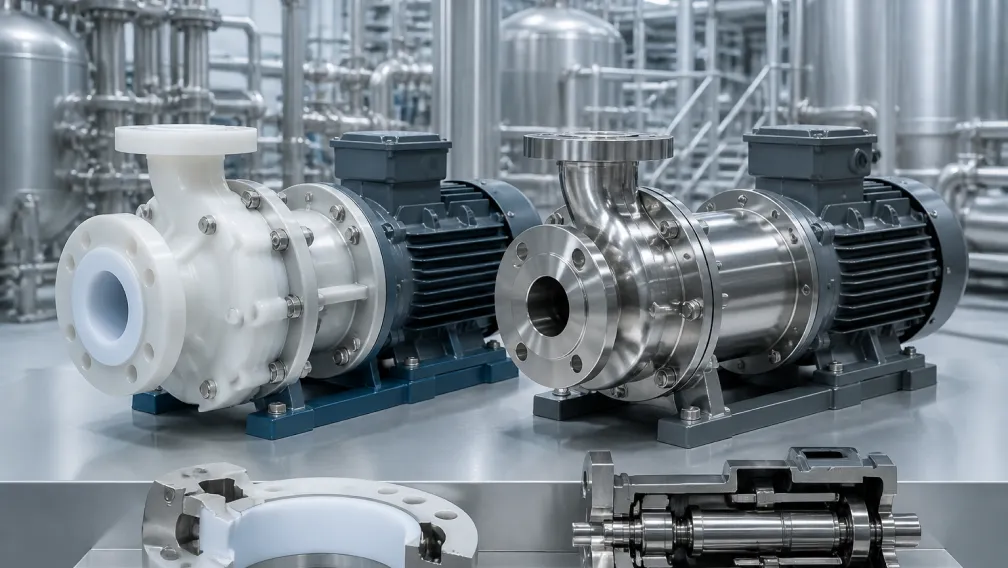
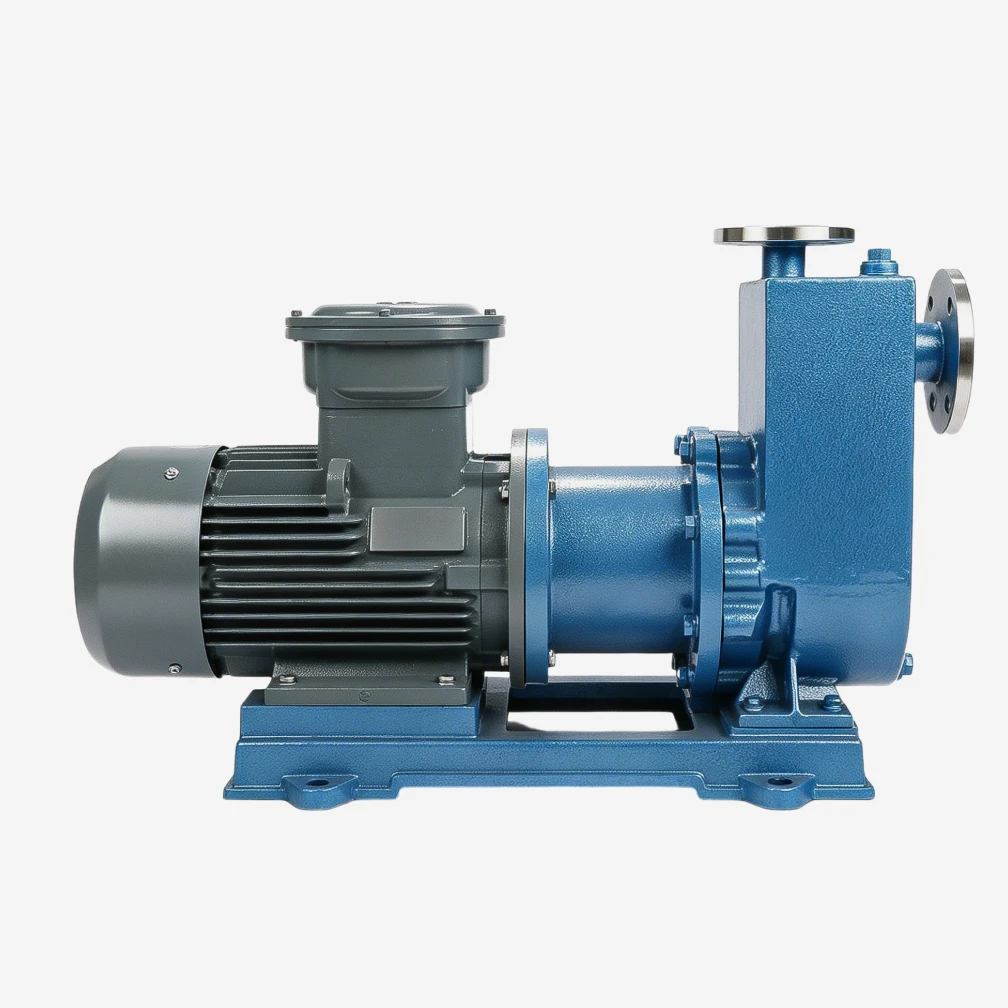
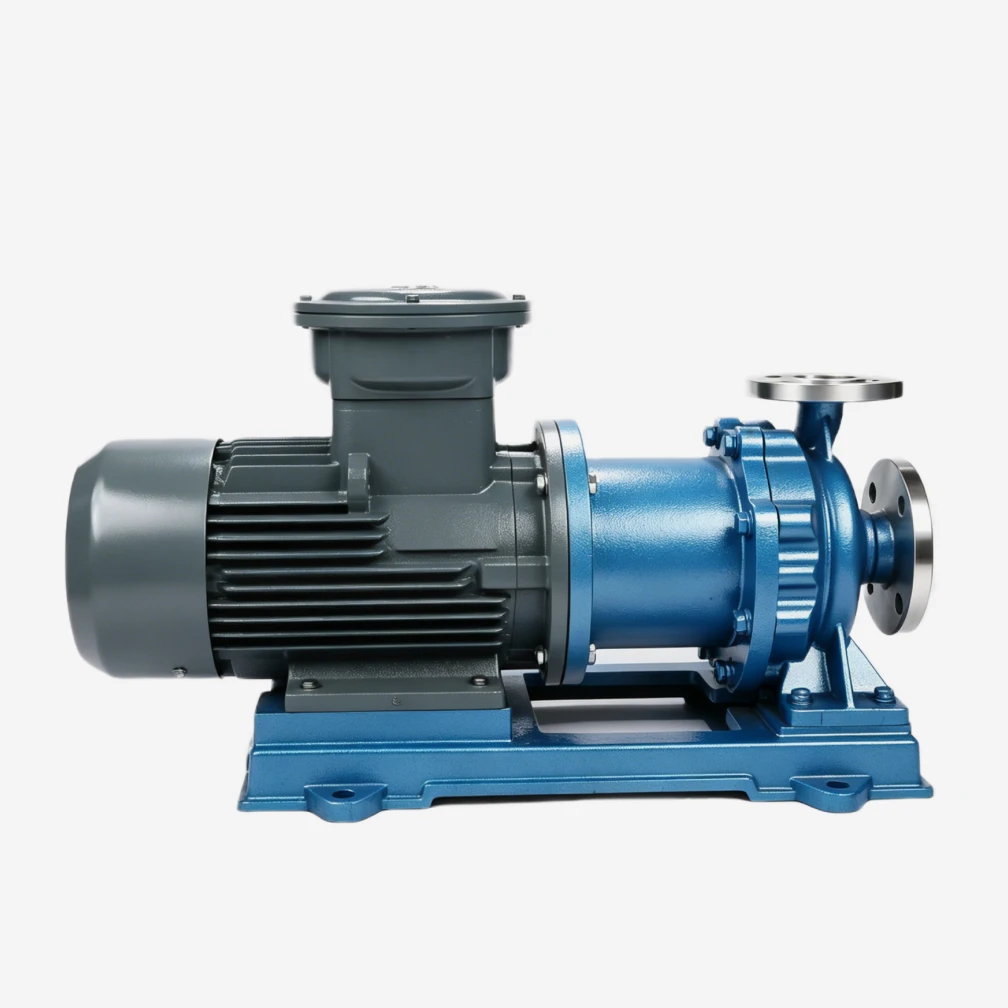
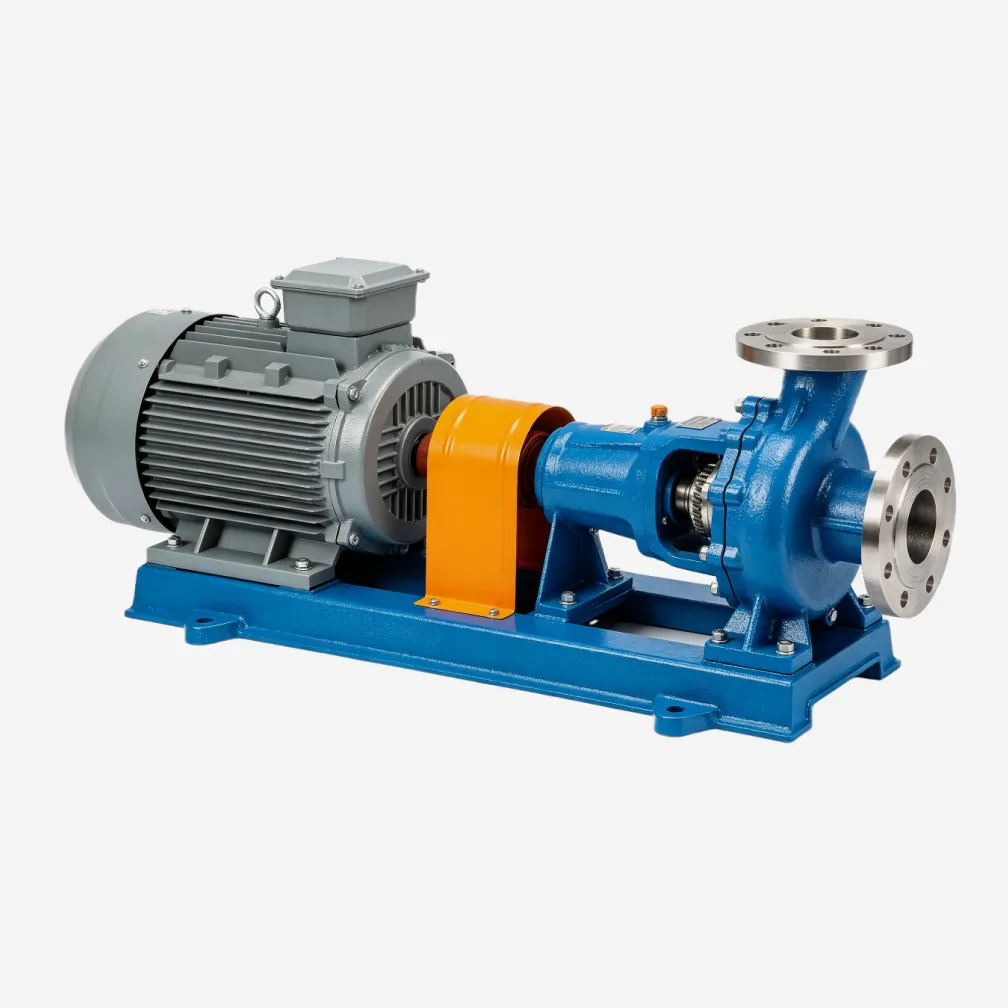
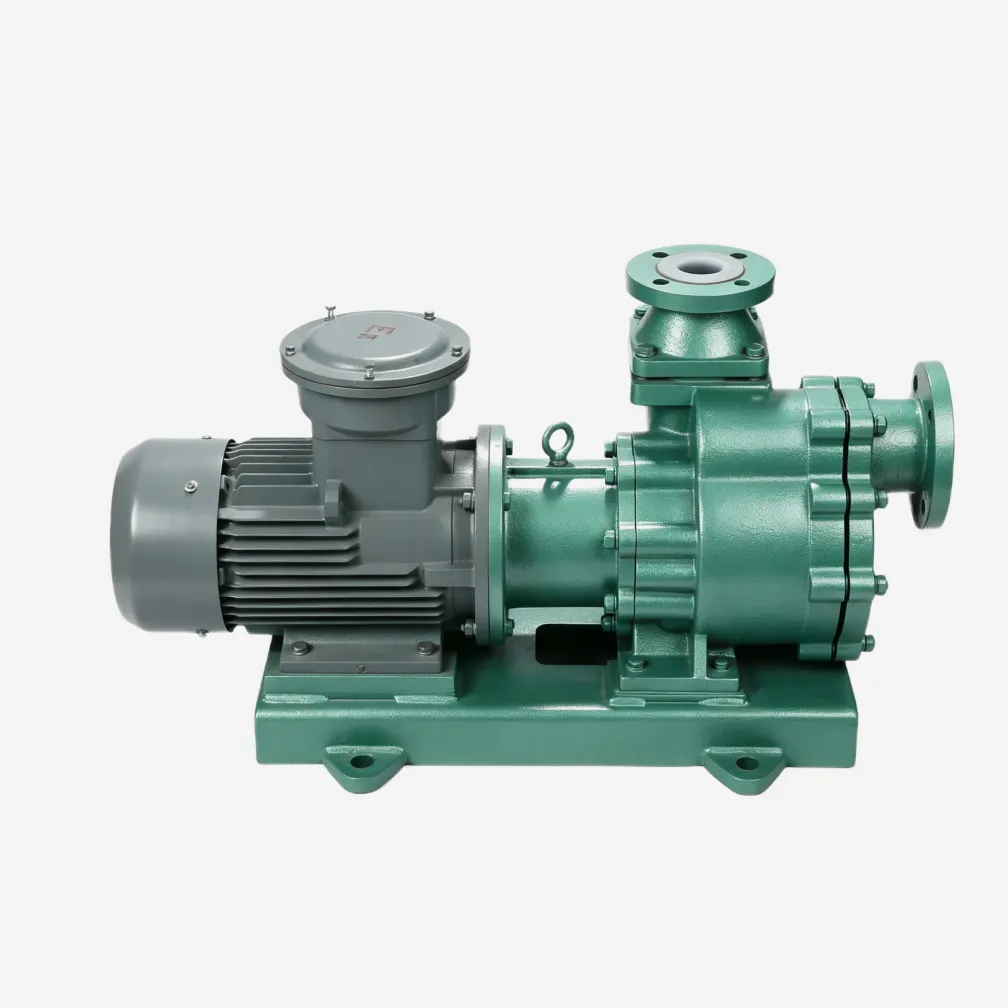
Sealless design earns its premium in classified areas. A fluoroplastic-lined magnetic drive pump removes the mechanical seal — historically the most frequent leak source on chemical pumps — so the flammable liquid stays behind a static containment shell and cannot feed the surrounding atmosphere. For solvent transfer, reactor circulation and tank-farm duties in Zone 1, the magnetic drive range paired with an Ex db IIB T4 motor is the standard configuration; our zero-leakage solutions page covers the system layout. Where hydraulics exceed the magnetic drive envelope, a lined centrifugal pump with a double mechanical seal and pressurized barrier fluid remains acceptable, provided the barrier system alarms on failure. For tanker unloading of flammable solvents, a lined self-priming pump handles the evacuation cycle without a foot valve — one less leak point at the unloading bay. Whatever the type, overheating stays the dominant ignition pathway, and our article on pump overheating and motor overload covers the protection philosophy in more detail.
Beyond the EU: IECEx and National Schemes
ATEX is law only inside the EU (with the UKCA mark now covering Great Britain separately), but its logic travels. The IECEx scheme certifies equipment against the same IEC 60079 and ISO 80079 standard families and is accepted across most of Asia, the Middle East and Latin America; markings use the same EPL codes. China operates its own mandatory scheme built on the GB/T 3836 series, with explosion-protected motors carrying CCC Ex certification and markings such as Ex db IIB T4 Gb that mirror the IEC format. North America still mixes the traditional Class/Division system with the zone-based Article 505. For export projects, specify the destination's scheme up front — an ATEX-only certificate does not automatically satisfy a Chinese or American inspector, although dual-certified equipment is common. The standards comparison in our ASME B73.1, ISO 2858 and API 685 guide shows how these regional layers sit on top of the hydraulic standards.
Selection Checklist: What to Specify
Explosion protection is specified with data, and our duty data sheet guide provides the framework. For classified areas, add these items:
- Zone classification from the operator's explosion protection document — gas or dust, and the zone number at the pump's exact location
- Gas group of the fluids present (check the safety data sheets; choose IIC when in doubt, since it covers IIA and IIB)
- Required temperature class, from the lowest auto-ignition temperature among the fluids handled
- Motor requirements: protection concept, gas group, T class, VFD operation, and the destination certification scheme
- Monitoring scope: bearing temperature, seal condition, dry-run protection
- Documentation package: EU Declaration of Conformity or IECEx/CCC certificates, manual with special conditions
Conclusion
ATEX selection is a matching exercise: the operator's zone meets the manufacturer's category, the gas group meets the marking, and the temperature class meets the fluid's auto-ignition temperature. Pumps add their own ignition physics — heat, sparks, static and dry running — which certified designs control through constructional safety, monitoring and sealless containment. Explore the chemical pump product range or contact our engineering team with your zone, gas group and duty point for an ATEX-compliant selection.
-

YFTEL Pumps
Fluid Engineers & Technical Support, YFTEL Pump
YFTEL is a chemical pump manufacturer based in Hangzhou, China, with a 26,000 m² production base in Hangzhou, China, with a 26,000 m² production base in Anhui. Using the CAS-patented Fluoroplastic Alloy material, we produce 300+ models of corrosion-resistant pumps, valves and piping, exported to 30+ countries.